In modern office equipment, the fixing unit of a copier is one of the core modules determining output quality and efficiency. Its core task is to firmly fuse toner onto the paper surface, a process highly dependent on a stable, uniform, and fast-responding heat source. Copier high-efficiency halogen lamps, with their superior infrared radiation characteristics, have become the mainstream heat source in high-end copier fixing systems. Their high infrared radiation efficiency not only improves heating speed and energy efficiency, but more importantly, through a non-contact radiative heat transfer mechanism, they achieve temperature uniformity far superior to traditional heated roller systems, thus significantly improving print quality and equipment reliability.
1. Infrared Radiation Heat Transfer: Achieving Non-Contact Uniform Heating
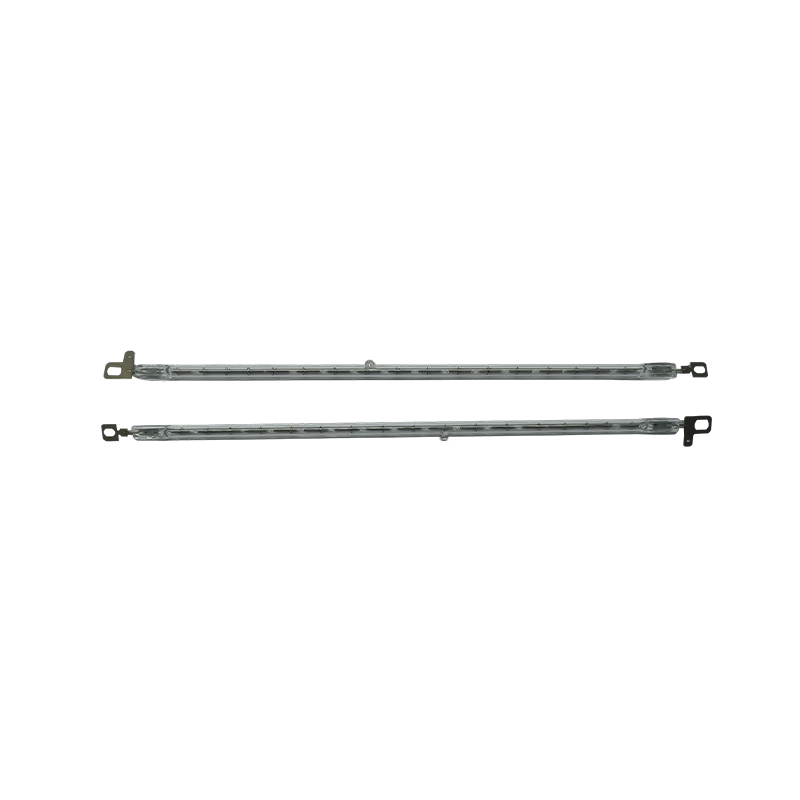
Traditional fixing technologies often use internal heating wires to heat a metal roller, which then conducts heat through direct contact between the roller surface and the paper. However, metal rollers suffer from high thermal inertia, slow heating, and rapid heat dissipation at the edges, easily leading to significant temperature differences between the center and sides of the paper, resulting in defects such as "over-melting in the center and blurry printing at the edges." High-efficiency halogen lamps utilize non-contact infrared radiation heating: after the lamp is powered on, the internal tungsten filament rapidly heats to over 2500℃, exciting a large amount of near-mid-infrared radiation with wavelengths concentrated in the 0.8–3.0μm range. This infrared radiation penetrates the air and is efficiently absorbed by the heat-absorbing coating on the surface of the fixing film or pressure roller, converting it into heat energy. Since radiant energy travels in a straight line at the speed of light, a highly consistent energy density distribution can be formed in the fixing area with a reasonable optical layout, fundamentally avoiding the path loss and edge cooling effect of conductive heating.
2. Synergistic Optimization of High Radiation Efficiency and Precise Optical Path Design
The high efficiency of high-efficiency halogen lamps lies in the fact that over 90% of their electrical energy can be converted into infrared radiation, and the spectral peaks highly match the absorption peaks of the fixing material. Based on this, copier manufacturers further control the spatial distribution of infrared energy through precise reflector and focusing lens designs. For example, using an elliptical cylindrical reflector cavity, placing the lamp at the first focal point, allows the radiated light to converge at the fixing zone at the second focal point; or adding power compensation zones at both ends of the lamp to counteract end radiation attenuation caused by electrode cooling. This integrated design of the "light source + optical system" ensures that temperature fluctuations are controlled within ±2℃ across the entire effective width from paper feed to output, from left to right, meeting the stringent requirements of high-speed, high-precision color copying for thermal uniformity.
3. Rapid Response for Dynamic Temperature Control
Another advantage of halogen lamps is their millisecond-level thermal response capability. As paper passes through the fixing zone, the system can adjust the lamp power in real time according to the paper size and weight—small-sized paper activates only the central lamp area, while large-sized paper operates at full power. This "on-demand heating" mode not only saves energy but also avoids overheating and aging during paperless periods. More importantly, because there is no need to preheat the bulky metal roller, the overall cold start time can be reduced to less than 10 seconds. The rapid heating and cooling capability also allows the system to dynamically compensate for changes in ambient temperature or heat accumulation during continuous printing, maintaining a stable fixing temperature over a long period and preventing uneven image gloss or toner shedding caused by temperature drift.
4. Simplified Structure Enhances Reliability and Maintainability
Thanks to its non-contact design, the halogen lamp fixing module eliminates the complex hot roller drive, cleaning, and scraper mechanisms, resulting in a more compact structure and fewer potential failure points. Simultaneously, the uniform temperature distribution reduces damage to the fixing film from localized overheating, extending consumable life. Users require virtually no intervention in daily use, truly achieving a "highly efficient, stable, and maintenance-free" office experience.
Copier high-efficiency halogen lamps, through the combination of high infrared radiation efficiency and precision optical design, accurately and evenly project heat energy into the fixing area in the form of light, completely revolutionizing the limitations of traditional conductive heating. It not only improves the consistency of fixing quality but also drives the evolution of copiers towards energy saving, speed, and miniaturization. In today's pursuit of ultimate office efficiency and output quality, this seemingly small light source is actually an indispensable "thermal engine" behind intelligent printing equipment.