How do printer high-efficiency halogen lamps achieve "second-level heating" to match the instantaneous passage of paper through the fuser roller in high-speed printing scenarios?
Publish Time: 2025-12-22
In modern office and industrial printing equipment, speed has become one of the core performance indicators. High-end laser printers or digital copiers typically achieve output rates of 60 pages per minute or even over 100 pages per minute. At such high speeds, the time it takes for paper to pass through the fuser unit is often less than 0.1 seconds. To completely melt the toner particles and firmly adhere them to the paper within such a short window, the fuser system must provide an instantaneous, uniform, and controllable high-temperature heat source. Printer high-efficiency halogen lamps, with their unique physical properties and optimized system integration design, have become the key technological support for achieving "second-level heating" and continue to play an irreplaceable role in many high-speed printing devices.
1. The Nature of Thermal Radiation: Near-Instantaneous Energy Transfer
Printer high-efficiency halogen lamps are thermal radiation light sources. Their working principle involves heating a tungsten filament to 2500–3000°C using an electric current, causing it to emit a continuous spectrum containing visible light and a large amount of infrared radiation. Infrared radiation accounts for over 80% of this spectrum, which is the key wavelength that toner efficiently absorbs and converts into heat energy. Unlike conduction or convection heating, infrared radiation travels at the speed of light, requiring no medium. It can directly penetrate the air and be absorbed by the toner layer and paper surface, achieving "heating upon irradiation." This non-contact heat transfer method fundamentally avoids the shortcomings of traditional hot plates or rollers, such as slow preheating and high thermal inertia, laying the physical foundation for second-level response.
2. Low Heat Capacity Structure: Hardware Guarantee for Rapid Start-up and Stoppage
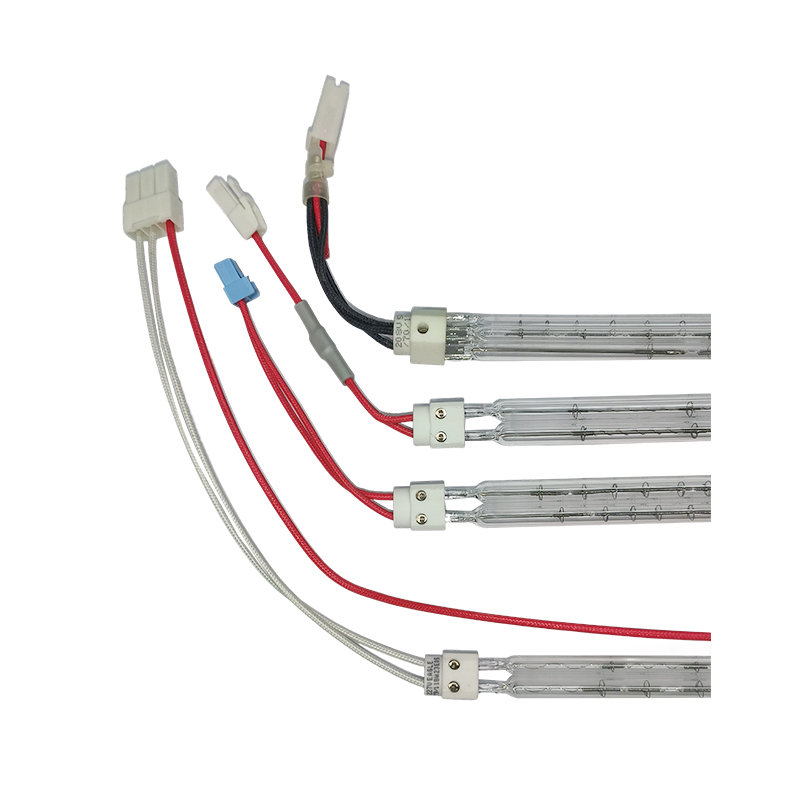
High-speed printing requires the fusing system to have "on-demand heating" capability—that is, it only activates strong heat output when paper is passing through, and quickly cools down to save energy when there is no paper. The key to printer high-efficiency halogen lamps' ability to perform this task lies in their extremely low heat capacity design. The lamp body is encapsulated in a thin-diameter, high-purity quartz glass tube, with a fine tungsten filament and a lightweight support structure, typically weighing only a few tens of grams. Compared to heavy metal heating rollers or ceramic heating elements, printer high-efficiency halogen lamps reach operating temperature from a cold state in just 2–5 seconds, with some optimized models even reaching 90% of rated power output within 1 second. This "rapid heating and cooling" characteristic perfectly matches the intermittent paper flow during high-speed printing, avoiding energy waste and paper overheating and curling.
3. Precise Power Control: Dynamically Matching Print Load
During continuous high-speed printing, the coverage of different pages varies greatly—the heat required to go from a blank page to a completely black image can differ by several times. If heating is constant, lightly loaded pages are prone to overheating and scorching, while heavily loaded pages may not fuse properly. Therefore, modern printers use a closed-loop temperature control system to dynamically adjust the printer high-efficiency halogen lamps at the millisecond level. The fusing roller incorporates a high-response thermistor or infrared temperature sensor to provide real-time temperature data feedback. The main control chip precisely regulates the halogen lamp's power supply voltage and on/off frequency using PWM technology based on parameters such as paper type, speed, and coverage. For example, it increases power 0.5 seconds before printing high-coverage images and automatically reduces power during paper gaps for standby. This intelligent power adjustment strategy ensures consistent fusing quality and extends lamp life.
4. Optical Focusing and Thermal Uniformity Design
Simply rapid heating is insufficient; uniform heating across the entire paper surface is also crucial. Printer high-efficiency halogen lamps are typically used with elliptical reflectors or gold-plated reflective layers to focus divergent infrared radiation onto the fusing line, creating a high-energy-density "tropical zone." Simultaneously, the lamp length covers the width of A3/A4 paper, and a special tungsten filament winding process optimizes axial temperature distribution, preventing poor fusing due to low edge temperatures. Some high-end models even employ a multi-lamp collaborative solution—the main lamp handles basic heating, while auxiliary lamps provide localized supplementary heating for high-coverage areas, further enhancing thermal adaptability.
5. System Integration and Reliability Enhancement
To cope with the high-frequency start-stop impact of high-speed printing, printer high-efficiency halogen lamps have undergone targeted enhancements in materials and processes. High-purity quartz tubes are heat-resistant and thermally shock-resistant; halogen gas concentrations are precisely proportioned to ensure efficient and stable tungsten evaporation-deposition cycles; and the electrodes utilize molybdenum foil sealing technology to prevent leakage failure. Furthermore, the printer features over-temperature protection and a lamp life counter, automatically prompting for replacement when an abnormality is detected or the lamp is nearing the end of its 4000-hour lifespan, preventing sudden power outages that could cause paper jams or fixing failures.
In the era of high-speed printing pursuing ultimate efficiency, printer high-efficiency halogen lamps, with their instantaneous infrared radiation, agile low-heat-capacity structure, precise intelligent power control, and system-level reliability design, have successfully solved the core engineering challenge of "second-level heating." Despite continuous advancements in energy efficiency and lifespan of solid-state light sources such as LEDs and lasers, high-efficiency printer halogen lamps still exhibit irreplaceable comprehensive advantages in fusing scenarios requiring high power density, wide spectral matching, and controllable costs. They are not only a prime example of the ingenious integration of thermal and optical technologies but also the unsung heroes behind high-speed printing, silently ensuring "every page is clear and durable."