In modern office and industrial printing systems, copier high-efficiency halogen lamps still play a crucial role as the core exposure light source in some medium-to-high-speed devices. They rely on the high-temperature emission of tungsten filaments and the halogen cycle mechanism to achieve stable and continuous light output, and use specific optical structures to uniformly illuminate the original. However, in high-speed continuous copying scenarios, factors such as high-frequency filament illumination, rapid temperature changes, and long-term operation can easily lead to unstable illumination and exposure fluctuations, thus affecting the clarity and consistency of the copied image.1. Optimize Power Supply Control to Improve Light Source StabilityThe light output stability of halogen lamps largely depends on the power supply system. Voltage fluctuations or unstable current control directly cause changes in filament temperature, resulting in light intensity fluctuations. Therefore, in high-speed copying systems, high-precision regulated power supplies and constant current drive technology are required to keep the filament within a stable operating temperature range. Meanwhile, soft-start control avoids thermal stress damage to the filament caused by instantaneous current surges, thus improving the overall stability of light output.
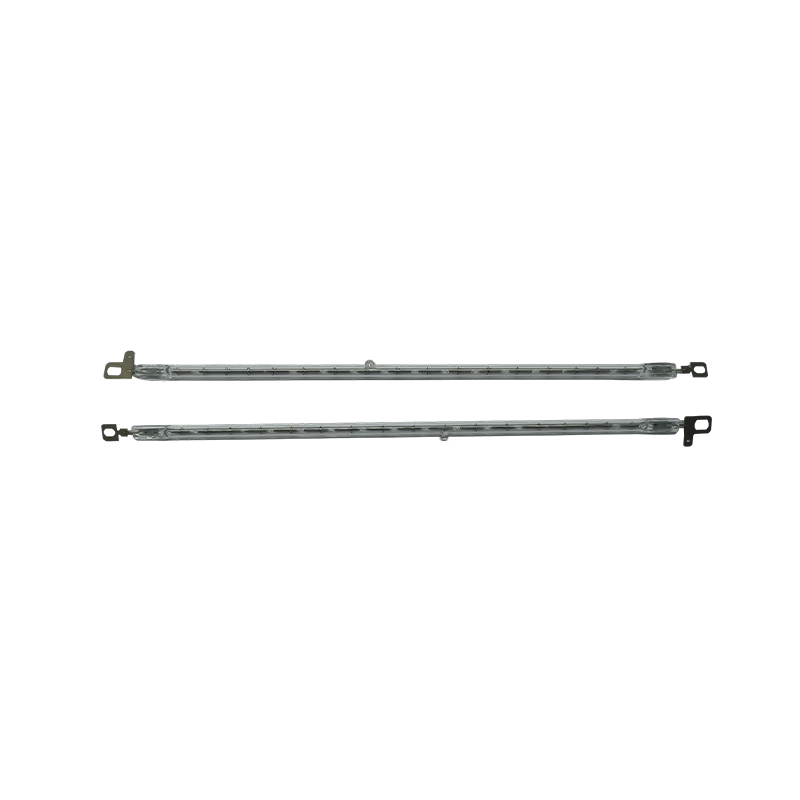
2. Improved Thermal Management Structure Reduces Temperature FluctuationsHalogen lamps generate a large amount of heat during operation. Uneven heat dissipation can lead to localized temperature differences within the lamp tube, affecting the consistency of light output. Therefore, optimizing the lamp holder structure and heat dissipation system is necessary to improve overall thermal balance. For example, using a lamp holder structure made of high thermal conductivity materials, combined with forced air cooling or a heat sink design, can effectively reduce localized overheating. Furthermore, maintaining the quartz lamp tube wall temperature within a reasonable range can also maintain the stability of the halogen cycle, thereby reducing light decay fluctuations.3. Optimized Filament Structure Improves Luminous UniformityCopier halogen lamps typically employ a segmented filament design to match the exposure requirements of the optical system. During high-speed continuous copying, an improperly designed filament structure can easily lead to uneven localized light emission, resulting in exposure deviations. Therefore, optimizing the filament arrangement density can make the light output more uniform. For example, employing differentiated wire-winding structures at both ends and the middle area allows for better compensation of lens edge attenuation in light intensity distribution, thereby improving overall exposure consistency.4. Enhancing Optical System Matching to Reduce Imaging ErrorsIllumination consistency depends not only on the light source itself but also on the optical system. An improperly designed optical path can amplify the impact of minute fluctuations in the light source on image quality. Therefore, it is necessary to optimize the design of the reflector and condenser system to improve light energy utilization and uniformity. Simultaneously, adjusting the exposure slit structure can maintain a stable light distribution during scanning, thereby reducing exposure differences caused by variations in mechanical scanning speed.5. Introducing Feedback Control for Dynamic CompensationIn high-speed continuous copying, static design alone is insufficient to completely eliminate exposure fluctuations. Therefore, a light intensity feedback control system can be introduced. This system uses photoelectric sensors to monitor the light output intensity in real time and feeds the data back to the control system for dynamic adjustment. When a decrease or fluctuation in light intensity is detected, the system can automatically adjust the power supply parameters to compensate, thus maintaining a stable exposure level. This closed-loop control method significantly improves consistency and stability during continuous copying.In summary, by optimizing power supply control, improving thermal management structure, optimizing filament design, enhancing optical matching, and introducing dynamic feedback control, the illumination consistency of copier high-efficiency halogen lamps in high-speed continuous copying scenarios can be effectively improved, and exposure fluctuations can be significantly reduced. This not only helps improve the quality of copied images but also extends the lifespan of the light source, providing stable and reliable optical protection for high-precision printing systems.