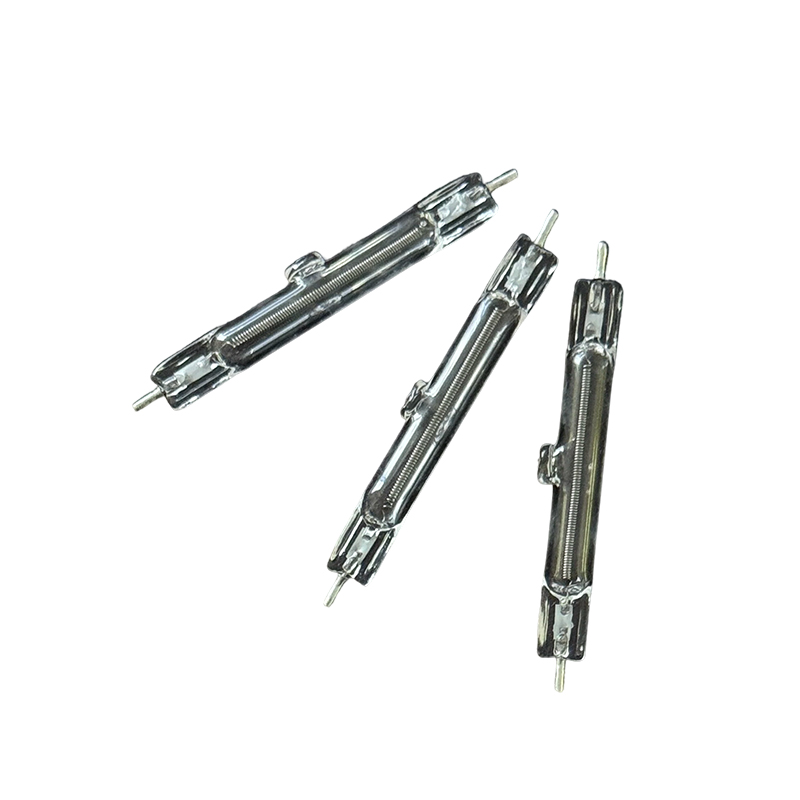
How does the hair removal device heating lamp work in conjunction with the sensor system to achieve precise temperature control in intelligent beauty devices?
Publish Time: 2026-04-27
Temperature control is one of the core factors determining safety and effectiveness in intelligent beauty devices. Hair removal device heating lamps are widely used in anti-aging devices due to their fast response speed and high thermal radiation efficiency.
1. Thermal Response Characteristics of Hair Removal Device Heating Lamps
Hair removal device heating lamps are characterized by rapid heating and high energy concentration, enabling them to transfer heat to the skin surface and subcutaneous tissue in a short time. This rapid response characteristic provides the foundation for precise temperature control, but it also means that temperature fluctuations are relatively large, requiring real-time feedback control using sensors to avoid overheating or uneven temperature distribution.
2. Real-time Monitoring by Temperature Sensors
In the system, temperature sensors continuously collect skin surface temperature data. This data is transmitted to the control system at high frequency, allowing the device to promptly grasp current temperature changes. When the temperature approaches a set threshold, the system can quickly adjust the heating power to achieve dynamic balance.
3. Closed-Loop Control System Improves Adjustment Accuracy
The key to precise temperature control lies in closed-loop control. By comparing sensor feedback data with the set target temperature, the control system can automatically adjust the output power of the halogen lamp. For example, it gradually reduces the power during the temperature rise phase and enters a fine-tuning state when approaching the target temperature, thus avoiding temperature overshoot. This closed-loop adjustment mechanism significantly improves temperature control accuracy and stability.
4. Multi-sensor fusion enhances safety
To adapt to different skin types and usage environments, modern beauty instruments often employ multi-sensor fusion solutions. In addition to temperature sensors, contact sensors and pressure sensors can be introduced to determine whether the device is correctly fitting the skin. When poor contact or abnormal conditions are detected, the system can automatically reduce or shut down the heating function, thereby improving safety.
5. Intelligent algorithms optimize temperature control strategies
Based on data, intelligent algorithms can further optimize the temperature control process. For example, by analyzing temperature change trends, the system can predict the rate of temperature rise in the next stage, thereby adjusting the heating power in advance. This "predictive control" is smoother than traditional feedback control, helping to improve the user experience and reduce temperature fluctuations.
6. Structural design ensures uniform heat distribution
Besides the electronic control system, the device structure also affects the temperature control effect. By optimizing the reflector and heat-conducting structure, the heat emitted by the halogen lamp can be evenly distributed over the treatment area, reducing the generation of localized hot spots. This collaborative design of the structure and control system contributes to a more stable temperature field.
7. User Interface and Personalized Adjustment
Intelligent beauty instruments typically offer multiple temperature settings or mode selections, allowing users to adjust according to their needs. The system then applies corresponding temperature control strategies based on different modes to achieve personalized heating. This human-computer interaction design ensures precise temperature control is reflected not only in the technology but also in the user experience.
In summary, the precise temperature control of the hair removal device heating lamp in intelligent beauty instruments relies on the collaborative efforts of real-time sensor monitoring, a closed-loop control system, and intelligent algorithms. Through multi-level optimization, not only can stable and safe temperature control be achieved, but the overall beauty effect and user experience can also be improved.